Skip to content
Call (760) 334-5946Licensed, insured and bonded · License #585047

Industrial and Business Park Painting in Carlsbad, Scheduled Around Working Tenants

Carlsbad Expert Painting is a trusted San Diego County specialist in business park painting in Carlsbad, CA, specializing in tilt-up wall repaints, roll-up door and canopy coatings and park-wide color matching. We offer multi-tenant repainting and flex building exterior painting for owners and property managers.

  • Free on-site estimate
  • Written scope, coat by coat
  • Colors you approve first

Get a free painting estimate

Or call (760) 334-5946. Calls only, we do not receive text messages.

About our industrial & business park painting

Our team provides tenant-by-tenant scheduling, delivering finished frontages while operations continue for both residential and commercial projects. We submit product data and paint a mockup area on the actual wall for your approval before a phased repaint, and we write the schedule by tenant frontage so each business knows its day.

From cleaning and sealing panel joints to priming metal doors and canopies, our team handles every detail. Serving Carlsbad, Encinitas, Solana Beach and Del Mar, we keep loading docks open and customer parking usable while the work moves through the park.

Why Carlsbad Expert Painting

How We Work

No salesperson hands you to a stranger. The person who measures the job answers for it.

Written scopePrep, primer and finish coats listed surface by surface
Colors firstSamples on your wall, and association submittals prepared for review
One crewThe crew that quotes the job is the crew that paints it
CA License #585047Licensed, insured and bonded

One owner, many tenants: scheduling around operations

A business park is a group of buildings on one site, usually owned or managed as one asset and leased to many tenants who each keep their own hours. That makes a repaint an owner's scheduling problem before it is a coating problem. The walls are one job. The tenants are several, and each has customers, deliveries or shifts that a lift and a tarp can disturb.

So we write the schedule per tenant frontage, not per building. Before work starts the property manager receives a sheet listing each suite, the elevation to be coated, the equipment that will stand in front of it, and the tenant's own constraints, such as receiving hours or a busy weekday morning. Tenants get the sheet through the manager, and a frontage is not started until the manager confirms that tenant has been told.

  • Frontages with loading docks are scheduled outside their receiving hours.
  • Customer-facing suites are scheduled away from their busiest periods.
  • Quiet tenants, such as a storage or back-office suite, are used as buffer sequence between the busy ones.

The start date and length for each frontage are written into the bid or the phase schedule rather than promised in a brochure.

Tilt-up panels, metal doors and canopies

Many business-park and flex buildings are tilt-up concrete. Panels are cast flat on a slab, cured, then tilted upright by crane and joined at embedded steel plates, so a finished wall is a set of large concrete elements with joints between them. Paint is one of the standard finishes for those panels, alongside stains and pigmented concrete.

Concrete panels

We wash the wall, note cracks, spalls and open joints, and list the repairs in the scope before coating. Primer is chosen for bare concrete and for previously coated concrete separately, because they do not accept a coating the same way.

Roll-up doors and metal

Roll-up doors, canopies, railings and downspouts are metal, and metal needs a different primer than concrete. Paint primers improve adhesion and can block stains, so bare or rusted spots are treated and spot-primed before the finish coat, and each metal item is a separate line in the bid.

Trim, signage bands and bollards

Accent bands, entry canopies, bollards and sign backing are listed so nothing is left in the old color beside a fresh wall. Carlsbad is a coastal city where marine fog is common in summer, so we check metal items and lower wall edges for corrosion staining at the walk-through. We do not print a salt-exposure figure, because none has been sourced for these parks.

Matching the park's color scheme

A business park usually has a master color scheme, and a single building repainted a shade off reads as a mistake beside its neighbors. The first place a mismatch appears is the chip: a swatch under warm store lighting rarely matches a wall that has weathered under sun for years.

So we match to the wall, not to the chip. We take the existing coating as the reference, brush out or spray a test area, and hold it up against the wall in daylight. Once the manager approves it, that patch stays on the wall as the standard for the rest of the phase, and we record the product, color and sheen for the park's file.

Where the scheme is being changed rather than kept, we paint a mockup on the actual building and photograph it in morning and afternoon light before any wall is coated. Glossier sheens show surface defects more, so a higher-sheen door or accent band is chosen deliberately, not left to default.

Lifts, loading and parking

Tall walls mean lifts or scaffold, and lifts need floor space in exactly the spots where tenants park and load. OSHA treats falls from scaffolds and lifts as a hazard controlled by following its standards, so equipment placement is planned rather than improvised on the morning of the work.

We work out lift positions per frontage before work starts and send them to the manager:

  • Where equipment will stand and which spaces or dock doors it takes.
  • Which parking rows need cones or a temporary closure, and for what part of the day.
  • A walking route that keeps customers and delivery drivers clear of the work area.
  • Overspray protection for vehicles, glazing and landscaping, with masking on the doors and windows along each wall.

Product data and safety data sheets are available to tenants through the manager, so a business next to the work can see what is being applied.

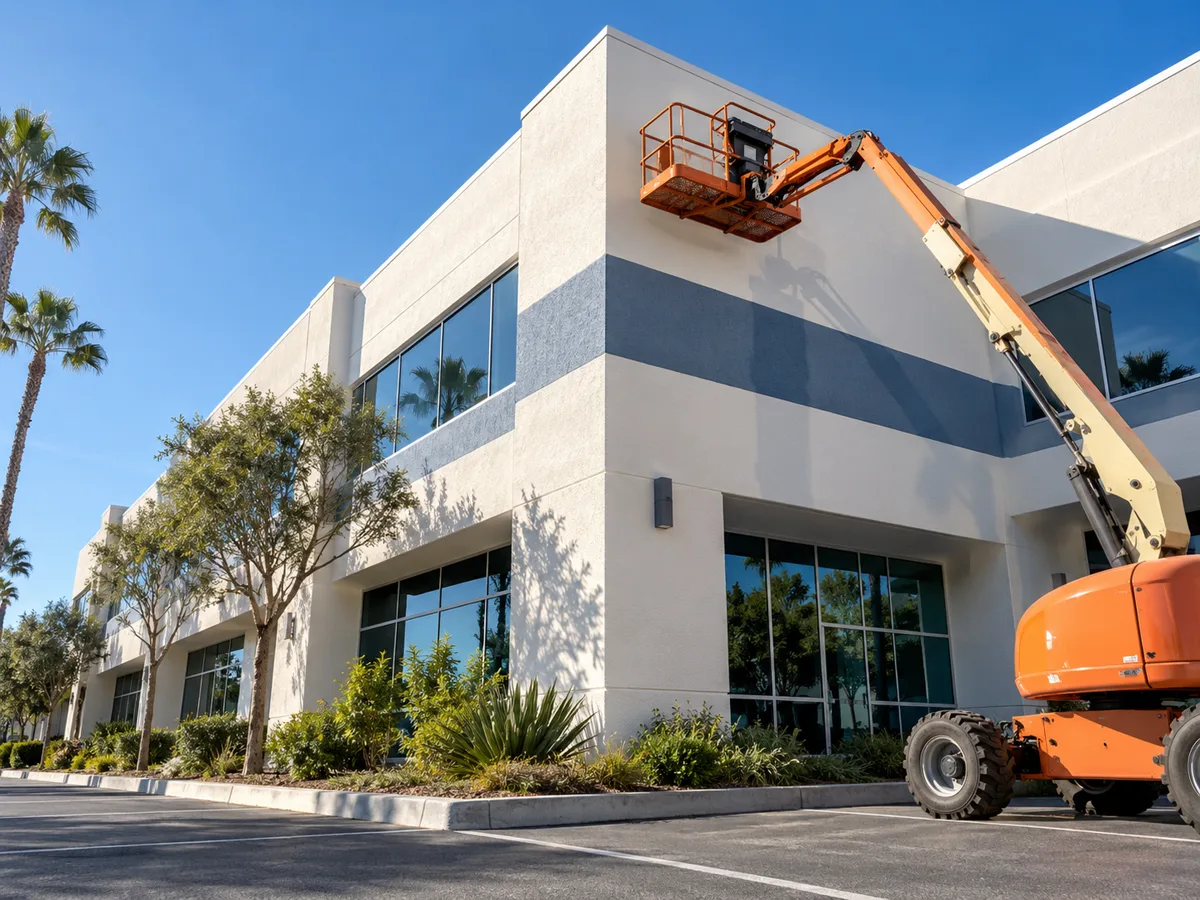
Two-story white stucco office building with a slate-blue horizontal band and tall glass windows, an orange boom lift raised against the wall beside a landscaped planter and parking lot, palms against a clear blue sky.

Cleaning, repairs and prep before any coat

Most of the durability of a repaint is decided before the first coat, and a business park has more to prepare than a tidy wall suggests. Loading areas collect dirt and tire marks, walls near landscaping collect growth, and a building that has been let go for years shows the disrepair that business-park critics point to as a risk when maintenance lapses.

  • Washing every wall so the coating bonds to the surface and not to the grime, with runoff kept out of tenant entries and drains.
  • Cracks, spalls and open panel joints listed with a location and a photograph, so the owner sees the repair scope before it is priced.
  • Rust on metal doors, canopies and railings treated and spot-primed.
  • Old sealant and failed edges cut back, so new material has a sound surface behind it.
  • Tenant signage, lights and conduit masked or temporarily released, and put back after the coating.

The prep list goes to the owner as a separate line from the coating, because deferring a repair is the owner's decision, and the owner should make it knowing what is behind the paint.

How a business-park bid is built

Business park and industrial painting is typically estimated at roughly $40,000 to $300,000 per contract, a budgetary range from painting trade data rather than a number for your park. The bid itself is built from the property.

  • Takeoff by building and elevation, in wall area and building height.
  • Surface types: tilt-up concrete, block, stucco, metal siding, doors, canopies and railings.
  • The coating system specified for each, and the primer each needs.
  • Wall repairs, joint work and cleaning before paint.
  • Lift or scaffold type, and how many times it must be moved.
  • Phases by tenant frontage, and the mobilizations that creates.
  • Night, early-morning or weekend work for tenants who cannot be disturbed.
  • Tenant notices, cones, signage and parking protection.
  • A punch list walked with the manager when each phase ends.

Send the site plan, the building count or a list of addresses, and your color scheme for a bid. Those figures are estimates, they are subject to change as the scope is confirmed on site, and the written quote sets the final price.

Colors and Finishes

The process

How a Painting Job Runs

Four steps, and nothing is painted until you have approved the scope and the colors.

  1. The walk

    We walk the house or property with you, look at the stucco, the trim and the old coating, and note what the sun, the salt air and the marine layer have done to each side.

  2. The written scope

    You get the prep, the products, the colors and the dates in writing. For an association or a building, the scope is phased so residents and tenants know which day is theirs.

  3. Prep, then paint

    Washing, scraping, patching and caulking come first, because that is what the paint holds on to. Then primer where it is needed and the finish coats.

  4. The final walk

    We walk it again with you before we call it done, and touch up anything you point at.

Questions

Industrial & Business Park Painting: Common Questions

Can you repaint while every tenant stays open?

Yes. The schedule is written per tenant frontage, with dock, customer and delivery constraints listed, and the property manager confirms each tenant has been notified before we start that frontage.

How do you match our park's existing colors?

We match to the weathered wall, not to a chip. A test area goes up on the actual building, the manager approves it, and it stays as the reference for every later wall in the phase.

Do you paint roll-up doors and metal canopies?

Yes, as their own bid lines. Metal gets a primer suited to it, with rust spots treated first, and the finish coat follows the color scheme.

Do you work on tilt-up concrete buildings?

Yes. We clean the panels, list cracks and open joints for repair in the scope, and coat with a system chosen for concrete.

What happens to customer parking and loading?

Lift positions and cone lines are planned per frontage and sent to the manager beforehand, so customers and deliveries are routed around the work instead of through it.

Can you work at night or on weekends?

Yes, for tenants who cannot be disturbed during business hours. Those frontages are priced with the after-hours work stated, and the calendar is longer as a result.

Do you handle one building or a whole park?

Either. A single building is one phase, and a whole park is a set of phases, each with its own schedule and punch list, so the owner can release them as budget allows.

Can you provide product data for our tenants?

Yes. Product data and safety data sheets go to the manager before work starts, and tenants can see them on request.

Do you clean and repair walls before painting?

Yes. Every wall is washed, and cracks, open joints and rust are listed with photographs as a separate scope line, so the owner decides what to repair and what to defer.

Who tells the tenants the schedule?

The property manager does, from a frontage sheet we prepare, and we do not begin a frontage until the manager confirms that tenant has been told.

Free on-site estimate

Talk to us about industrial & business park painting

Homeowners get a free on-site estimate. Boards, managers and contractors can send a scope for a bid.

Call to Discuss Scope

Licensed, insured and bonded · License #585047. Calls only, we do not receive text messages.

Call (760) 334-5946Licensed, insured and bonded · License #585047