Skip to content
Call (760) 334-5946Licensed, insured and bonded · License #585047

Apartment Turnover Painting in Carlsbad: Vacant Units Ready for the Next Lease

Carlsbad Expert Painting is a trusted San Diego County specialist in apartment turnover painting in Carlsbad, CA, specializing in vacant-unit repaints, touch-up between tenants and property-wide color standards. We offer per-unit turn painting and full unit repaints for on-site managers and asset owners.

  • Free on-site estimate
  • Written scope, coat by coat
  • Colors you approve first

Get a free painting estimate

Or call (760) 334-5946. Calls only, we do not receive text messages.

About our apartment turnover painting

Our team provides make-ready painting that fits between repairs and flooring, delivering matched walls, ceilings and trim for both residential and commercial projects. The crew that walks the empty unit with your manager is the crew that paints it, and we write a scope for each turn that names the patching, the primer and the number of coats.

From nail-hole patching and stain-blocking primer to matching a property's standing color and sheen, our team handles every detail. Serving Carlsbad, Encinitas, Solana Beach and Del Mar, we take a turn from move-out walk-through to a unit that is ready to show.

Why Carlsbad Expert Painting

How We Work

No salesperson hands you to a stranger. The person who measures the job answers for it.

Written scopePrep, primer and finish coats listed surface by surface
Colors firstSamples on your wall, and association submittals prepared for review
One crewThe crew that quotes the job is the crew that paints it
CA License #585047Licensed, insured and bonded

Paint's slot in the make-ready calendar

A vacant unit is a calendar problem before it is a painting problem. The tenant has left, the next lease has a start date, and between those two dates sit cleaning, repairs, flooring and paint, each waiting on the one before it. Every day a unit sits unfinished is a day of rent the property does not collect, so a turn that runs late costs more than the coat of paint it was waiting on.

Paint belongs after the drywall patches and door or fixture repairs have been sanded, and before the flooring crew arrives, because a roller drops far less trouble onto bare subfloor than onto new carpet. Cleaning comes last. When the painter has a named slot on the manager's board, the whole sequence moves in order. When the painter is squeezed in wherever there is a gap, flooring arrives to wet walls and the next move-in slips.

At the start of each turn we ask the on-site manager for four things:

  • The move-out date and the next move-in date for the unit.
  • The repair list, so patching happens before the primer instead of after it.
  • The property's color and sheen schedule, covered in the next section.
  • Access: keys, gate codes and whether the unit is upstairs.

The start date and length for each unit are written on the work order against your move-in date, not promised in a brochure.

One color and sheen spec per property

A property that repaints each unit in whatever off-white the last painter had on the truck ends up with walls that differ from unit to unit, and a touch-up that shows as a patch. The cure is a written specification: one wall color, one ceiling color and one trim color, each with a sheen, kept on file for the whole property so any painter can match any unit.

Sheen matters as much as color. Flat paint hides imperfections but does not wash well, which suits ceilings and damaged walls. Eggshell and satin wash far better, so they suit living areas, kitchens and bathrooms, while semi-gloss is the usual choice for trim and doors because it shrugs off scuffs. A spec that names the sheen for each surface is what lets a second visit match the first.

The first time we turn a unit at a property, we record the spec by product, color name and sheen, and we brush out a sample on a wall you approve before that color goes into a second unit. Color choice also affects smell. Each ounce of colorant added to tint a paint can carry 5 to 20 grams of volatile organic compounds, so a light neutral spec keeps a freshly painted unit from following the next tenant in with a strong odor.

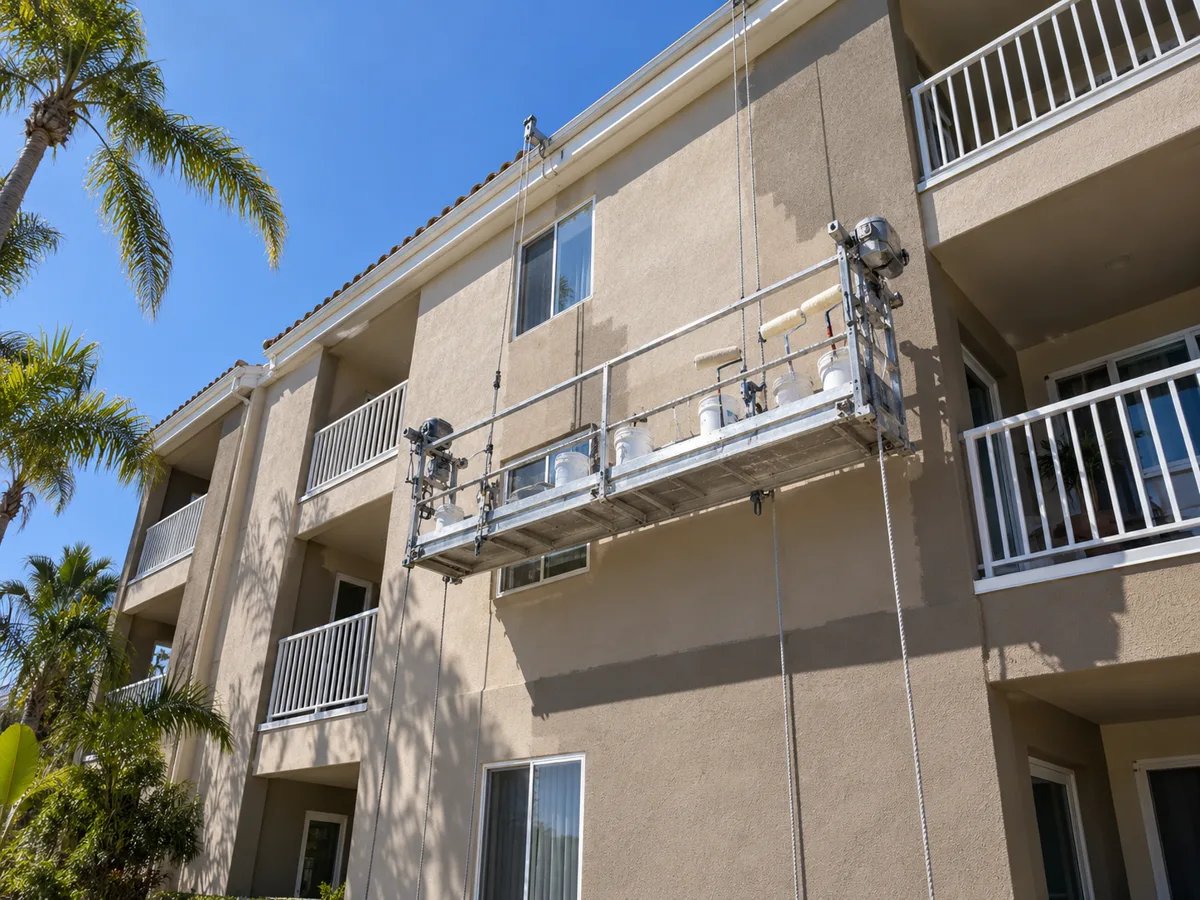
Three-story taupe stucco apartment building with white balcony railings and a suspended swing stage holding paint buckets and rollers, no one on it.

Touch-up or full repaint

The touch-up or repaint decision is made at the walk-through, from the condition of the walls, and not from the calendar.

Touch-up

Scuffs, nail holes, small dents and marks around switches and door frames can be patched and spot-painted when the existing coat is sound and still matches the spec. Spot-painting only works if the wall holds the same product and sheen. Over an older or different paint, a touched-up patch shows as a square in raking light.

Full repaint

Where walls are stained, yellowed by smoke or grease, marked across large areas, or carry a previous tenant's bold color, a full repaint over primer resets the unit. A dark color going to a light neutral needs that primer, or the old color bleeds through the finish coats.

Ceilings and trim

Kitchen and bathroom ceilings show moisture and grease first, and baseboards and doors take most of the scuffs. We price them as their own lines so a manager can approve trim work without repainting every wall. At the walk-through we photograph the walls and put the touch-up or repaint decision in writing for each unit, so the choice is on record before any paint is opened.

Wear, damage and the deposit

Paint sits at the center of many deposit questions, because a deposit can be charged for damage but not for normal wear. California Civil Code section 1950.5 allows a landlord to deduct for repair of damage beyond ordinary wear and tear and for cleaning needed to return the unit to its move-in level of cleanliness. It does not allow deductions for damage that existed before the tenancy or for ordinary wear and tear. The statute also calls for an itemized statement within 21 calendar days after the tenant vacates, and for photographs taken after possession comes back and after repairs are finished.

We do not decide what a deposit covers. That is between the manager, the lease and counsel. What we do is describe the paint condition in plain terms on the work order so the manager can decide: fading and light scuffing from ordinary living are one thing, while crayon across a wall, large holes, smoke staining or an unapproved color are another. Where a unit is charged back to a former tenant, the work order lists each wall and surface on its own line with photographs, so the itemized statement has something to point to.

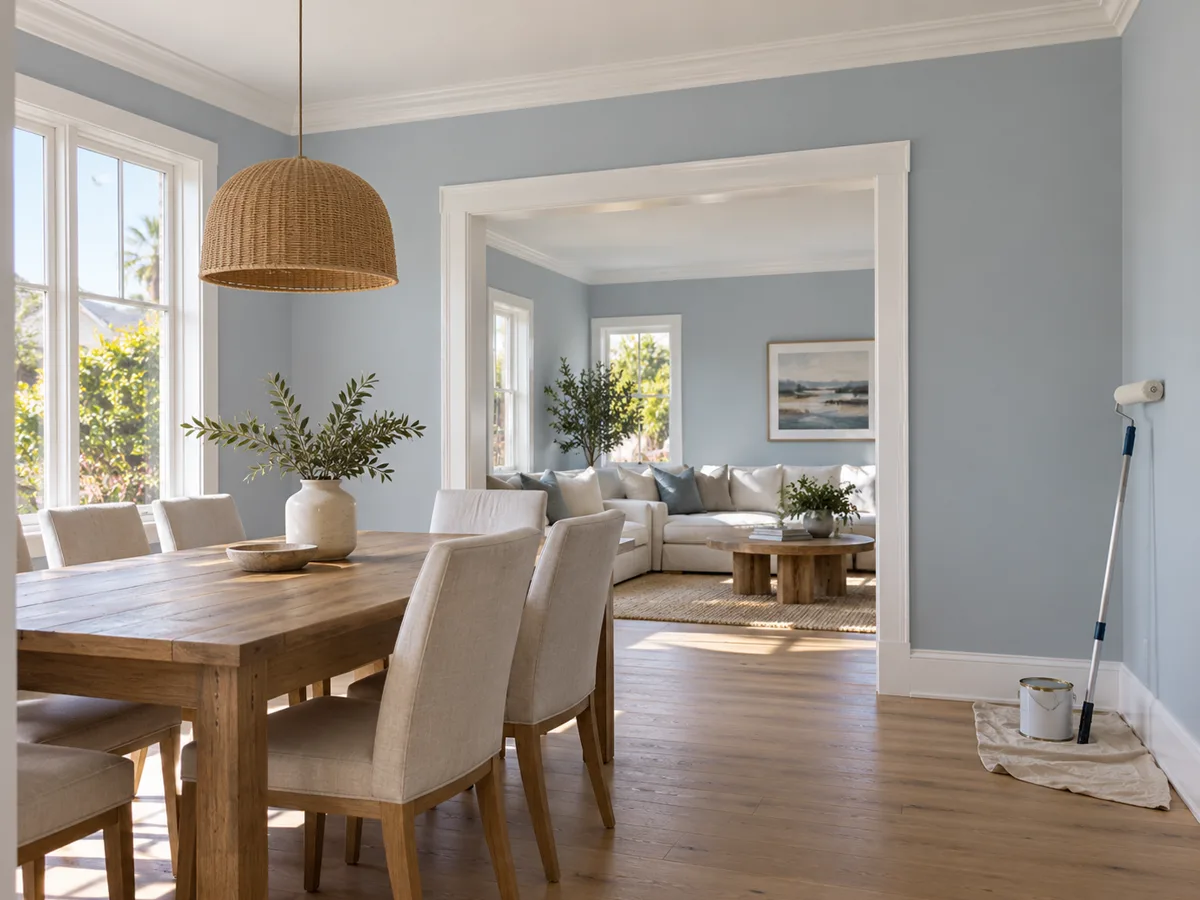
Dining and living room with soft blue-grey walls, white trim and crown moulding, a wood dining table under a woven pendant, and a roller on an extension pole beside a paint can in the corner.

Older buildings and lead-safe work

Lead-based paint was banned for residential use in the late 1970s, and the EPA's Renovation, Repair and Painting rule covers paid work that disturbs painted surfaces in housing built before 1978. Property managers who perform such work are covered as well as outside contractors.

So we ask the year built when a property first calls. On an older building, the scope describes lead-safe work practices: containment of the work area, wet methods and a cleanup that leaves the unit ready for the next tenant. If a unit's age changes the plan, the manager hears it before the schedule is set, not on the day the crew arrives.

How per-unit turn pricing is estimated

Apartment turnover painting is typically estimated at roughly $300 to $900 per unit, a budgetary range from painting trade data rather than a quote for your building. Where a unit lands in that range depends on the following.

  • Unit size and ceiling height, and the unit type mix across the property.
  • Touch-up or full repaint, decided at the walk-through.
  • Number of colors in the property spec and whether ceilings and trim are included.
  • Primer for stains, smoke or a dark previous color.
  • Patching and repairs needed before paint.
  • How many units are released at once, since a batch is easier to sequence than a single unit.
  • Access, such as upstairs units or gated entries.
  • Extra containment on pre-1978 buildings.

Send the unit count, the unit mix and your color spec for a bid with a price schedule by unit type. Those figures are estimates, they are subject to change once the scope is confirmed at the walk-through, and the written quote sets the final price.

Colors and Finishes

The process

How a Painting Job Runs

Four steps, and nothing is painted until you have approved the scope and the colors.

  1. The walk

    We walk the house or property with you, look at the stucco, the trim and the old coating, and note what the sun, the salt air and the marine layer have done to each side.

  2. The written scope

    You get the prep, the products, the colors and the dates in writing. For an association or a building, the scope is phased so residents and tenants know which day is theirs.

  3. Prep, then paint

    Washing, scraping, patching and caulking come first, because that is what the paint holds on to. Then primer where it is needed and the finish coats.

  4. The final walk

    We walk it again with you before we call it done, and touch up anything you point at.

Questions

Apartment Turnover Painting: Common Questions

Can you paint a unit between move-out and the next move-in?

Yes, when the turn is on the calendar. The start date and length are written on the work order against your move-in date, and paint is slotted after repairs and before flooring.

Do you match the color already in the unit?

We match your property spec first. Where there is no spec, we brush out a sample on a wall you approve, record the product, color and sheen, and keep it on file for every later turn.

Can you handle several units at once?

Yes. The bid carries a price schedule by unit type, and the manager releases units in batches as they come vacant, so the crew moves from one open unit to the next.

Who decides between touch-up and a full repaint?

We recommend at the walk-through from the condition of the walls, with photographs, and the manager approves the choice in writing for each unit.

Do you protect flooring and fixtures?

Yes. Floors, cabinets and fixtures are covered or masked, and paint debris is cleaned up before we leave. Your final make-ready cleaning still follows the paint.

Can you document wall condition for the deposit file?

Yes. Photographs and a wall-by-wall description go on the work order. What a deposit covers stays a decision for you and your counsel.

Does the same page cover repainting an occupied apartment community?

No. This scope is vacant units only. The occupied exterior of a community, with resident notices and parking moves, is a different job on our apartment repainting page.

Can we set you up as the standing painter for a property?

Yes. A standing color spec on file plus a work order for each turn is the simplest arrangement, and it keeps every unit matched.

Free on-site estimate

Talk to us about apartment turnover painting

Homeowners get a free on-site estimate. Boards, managers and contractors can send a scope for a bid.

Call to Discuss Scope

Licensed, insured and bonded · License #585047. Calls only, we do not receive text messages.

Call (760) 334-5946Licensed, insured and bonded · License #585047